Reading PLUS is widely used by schools and colleges across the US. While it can be a valuable LMS for college students to build stamina in college-level texts, Reading PLUS often gets backlash for having repetitive texts, strict pacing, and weekly lesson quotas. All this can make it hard to stay motivated.
If you are someone who is frustrated with LMSs, this guide is for you. We have included:
- Reading Plus really is
- How it works in college
- Why students find it difficult
- Whether looking for Reading PLUS answer keys is worth the risk
Let’s explore how the platform works and the best ways to improve your scores.

Key Takeaways: Strategies to Complete Reading PLUS Assignments
- The program rewards both speed and understanding; rushing often lowers comprehension.
- Keep your eyes relaxed and moving with the window, not fighting it.
- Making predictions and asking questions keeps you engaged and improves retention.
- Identify why your answer was incorrect (misread detail, wrong inference, vocabulary issue).
- Tracking your own progress (e.g., in a notebook or simple spreadsheet) increases motivation and persistence.
What Is Reading PLUS?
Reading PLUS is a web-based literacy program designed for students in grades 3–12 that personalizes reading practice to build fluency, comprehension, vocabulary, stamina, and motivation.
It is evidence-based, adaptive instruction that can produce around 2.5 years of reading growth in about 60 hours of personalized practice.
Is Reading PLUS Used in College?
Yes! Colleges use Reading PLUS alongside major LMSs, e.g., Canvas, Blackboard, and Moodle, to improve silent reading fluency, comprehension, and vocabulary to succeed in college‑level texts.
Reading PLUS is typically used in college for:
- Diagnostic placement: Colleges place an adaptive assessment (InSight) in college‑level texts for students on an appropriate reading level.
- Targeted intervention: The structured silent reading practice improves:
- Fluency (speed with comprehension)
- Comprehension and vocabulary
- Reading stamina and confidence
- Progress tracking: Instructors and support staff use the dashboards to monitor students’ growth and improvement for retention or grant reporting.
Which College Students Might Use Reading PLUS?
Community colleges and technical colleges use Reading PLUS for:
- Remedial/developmental reading courses
- Bridge or college‑readiness programs
- Support for students in high‑reading‑load programs (e.g., health sciences, nursing)
How Does Reading PLUS Work?
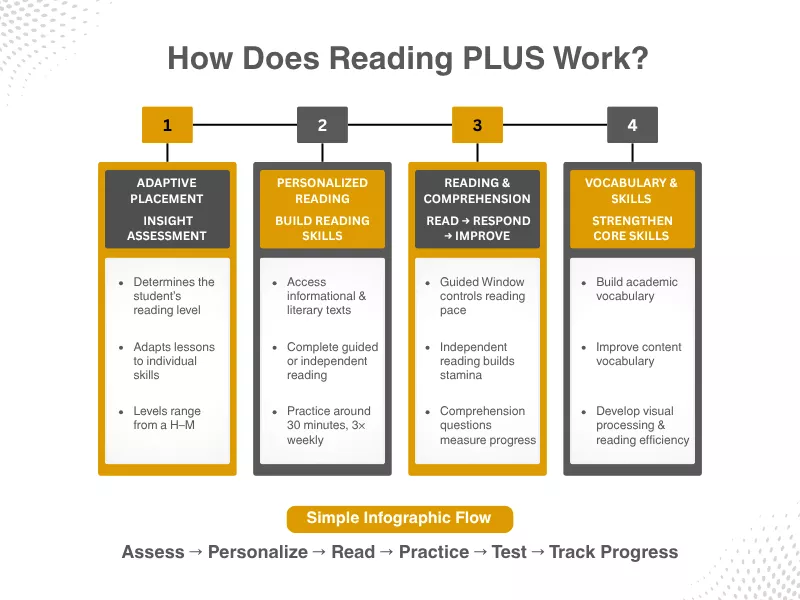
Once a student logs in using their school portal/LMS, they get assignments. Students are required to complete 5 reading lessons and 1 vocabulary task per week.
1. Adaptive Placement (InSight assessment)
Reading PLUS actually spans levels A through M (where A–K corresponds to grades 1–11, and L–M represents college readiness). Students need to take the InSight assessment or Reading PLUS Quiz so instructors can understand which reading level is best suited for the student.
The adaptive assessment is based on an AI algorithm that customizes the complete coursework for the student. This is similar to getting accurate ALEKS answers in the AP test for colleges.
2. Personalized Reading Lessons
Students get access to a large library of informational and literary texts. Therefore, one needs to put in ~30 minutes, 3 times per week to complete the session and get accurate Reading PLUS answers.
Guided and Independent Reading:
- One of the most unique features of Reading PLUS is that many lessons use a Guided Window. This window moves across the text at a controlled rate (G‑Rate) to train efficient eye movement and pacing.
Tips for College Students: If you are planning to search for Canvas quiz answers hack and not get caught for fidgeting eye movements, you can actually utilize Reading PLUS to practice eye movement.
- Another interesting feature includes lessons using independent reading (I‑Rate) where students progress through the text on their own, building stamina. The entire self-learning is based on this principle.
Once a student learns a particular text, they need to take a test of about 10 comprehensive questions. The system then reviews both reading rate and comprehension accuracy to understand how much the student progressed.
3. Vocabulary and Skills Components
Reading PLUS modules include focused activities to help students build academic and content vocabulary and visual skills that mainly help target visual processing and efficiency of a student.
Why Do Students Find Reading PLUS Difficult: Common Reading PLUS Challenges
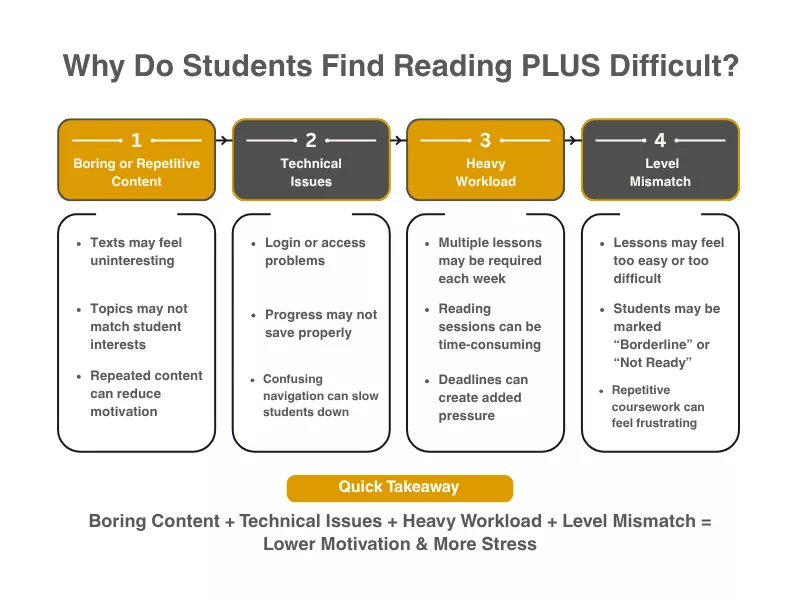
While designed to help students improve comprehension, Reading PLUS itself poses unique challenges for students, making it difficult to complete homework and improve Reading PLUS scores:
Boring or Irrelevant Content
One of the most common complaints about Reading PLUS is that the story and article selections are uninteresting. Moreover, students also complain that they do not align with their interests, and sometimes feel childish or repetitive.
Now, if you are a student who is already enrolled in Pearson MyLab English, you, of course, are bored of rereading the same texts over and over again. On top of that, if your instructor asks you to take Reading PLUS so you can improve text comprehension and get accurate MyEnglishLab answers quickly, chances are you will be bored to death.
Technical and Usability Issues
Glitches, outdated UI, and frustrating navigation are actually the most common complaints against most LMSs. Reading PLUS is no different. Students have complained that they have encountered login issues, unsaved progress, or confusing dashboards, taking them longer to work on assignments and get accurate Reading PLUS homework answers. Therefore, students usually search for strategies to complete Reading PLUS assignments.
High Workload and Time Pressure
Schools and colleges often require multiple lessons per week (e.g., 5–6 Reading PLUS assignments weekly), which can take over an hour for some students.
Now, for a college student who is already neck deep in assignments and also has a job, taking Reading PLUS classes becomes a challenge. Therefore, getting external English exam help becomes quite a popular choice among students.
Mismatch with Student Skill Levels and Needs
Just as many LMSs do not consider students ready enough to move ahead with assignments, Reading PLUS often identifies students as “Borderline” or “Not Ready.” Unlike ALEKS, where students complaint getting assignments beyond their academic level, Reading PLUS is notorious for designing redundant or lower-level coursework than the actual grade level of the student.
All these make students avoid Reading PLUS and lower their motivation level. Now that you know why students search for Reading PLUS answers online. Let’s understand whether you can find answers online and identify fake academic services.
Should You Look for Reading PLUS Answers?
If you dislike the Guided Window that moves across the text a few words at a time, forcing you to read at a pre‑set speed, or large class sizes and limited individual support, you might be searching for Reading PLUS answers online.
Undoubtedly, getting answers online or using Do My Homework service can help finish off the assignments quickly and also improve your score. Furthermore, since for most college students this is an added task, outsourcing Reading PLUS assignments actually gives you enough time so you can concentrate on major subjects.
Is There a Reading PLUS Answer Key?
Actually no. Most students head to Reddit to get a Reading PLUS answer key. However, answer key threads are unverified, outdated, or incorrect. In fact, Reading PLUS is an adaptive, computer‑based assessment, so it randomizes the questions. Therefore, if you get the Reading PLUS answer key, you may still perform poorly while risking penalties. Instead, you can hire a take my online class expert because they solve the questions in real time, offering accurate and precise Reading PLUS homework answer keys.
So, how do you get better grades?
How to Get Better at Reading PLUS: 5 Tips to Improve Your Score
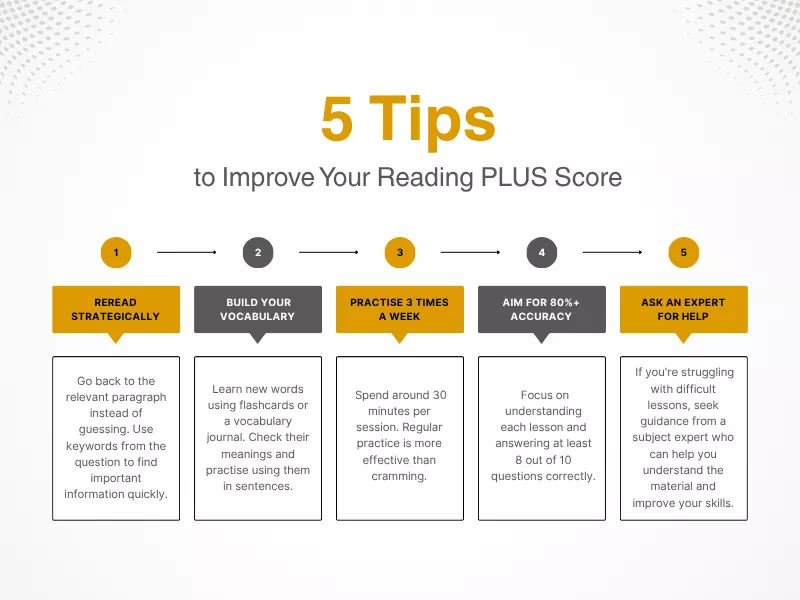
Here are 5 best strategies for improving scores on digital reading comprehension tests:
Use the Reread Button Strategically
If you find the question confusing, you need to reread the relevant part of the passage instead of guessing. Most Reading PLUS assignment answers are available in the paragraph; therefore, re-reading the key paragraphs states main ideas, reasons, or evidence.
To find the key paragraph, just copy one or two keywords from the question, and use CTRL + F on Windows and Command + F on macOS (Macs) to quickly find the word in the paragraph.
Build Vocabulary Outside the Program
Having a good vocabulary can help you complete Reading PLUS assignments more effectively and finish tests more quickly. Therefore, you can build vocabulary by using a journal or flashcards. When learning a word, look up meanings and then use them in your own sentences.
Keep a proper notebook so you can refer to it whenever you need.
Practice Regularly (At Least 3 Sessions/week)
You need to be consistent and invest 30 minutes in each session weekly. Consistent, shorter sessions work better than cramming many lessons in one day.
Aim for 80%+ Comprehension on Each Lesson
Reading PLUS usually has around 10 questions, so if you get 8/10 or higher, that will be enough. This is because most schools set this target. Therefore, instead of trying to do it all, ensure you get 8 absolutely correct to move to the next activity or module.
Get Help with Reading PLUS from a Subject Expert
Reading PLUS quiz answers or homework answers are not always available online. Therefore, you need to search for subject experts who know how the LMS works so you can get accurate answers online. BuyOnlineClass Services is designed to help high school and college students get the help they need to succeed in online classes.
Conclusion
Reading PLUS may not be the best of all LMSs, but it is useful for students for reading comprehension. For most learners, it’s a valuable tool as it can deliver up to 2.5 years of reading growth in around 60 hours of personalized practice.
However, if you find it hard to work with because of repetitive assignments, you can use the tips mentioned here. Lastly, you can also come to us to get help with your Reading PLUS assignments, since we are available 24/7.
Frequently Asked Questions
Is Reading PLUS used in college?
Yes! Reading PLUS is primarily used in college for adult literacy programs. This helps in developing reading courses and building vocabulary, comprehension, and silent reading fluency for remedial instruction in college-level work.
Does Reading PLUS track cheating?
No, it does not have any built-in tracker. However, it uses standard metrics like time-on-task, reading rate, and quiz scores. Therefore, answer sharing or code hacks do not always plan out well.
How long does it take to complete Reading PLUS assignments?
While it usually takes 15 minutes for reading, 10 minutes for vocabulary, and 10 minutes for visual skills, the time needed to complete a Reading PLUS assignment is actually subjective. For every student, the time taken might be different depending on their command and grasping pace.
How to get help with difficult passages in online reading programs like Reading PLUS?
You can use built-in navigation tools such as the Reread button during comprehension questions. Moreover, you can consult with your teacher or parent for targeted skill resources, and rely on the program’s auto-adjusting pacing scaffolds. You can also hire an expert to get help.
What are common challenges in student reading acceleration programs like Reading PLUS?
Students often face the following challenges:
- repetitive digital interfaces;
- frustration with rigid pacing controls;
- lack of deep comprehension strategies;
- No proper and direct teacher guidance;
- technical hurdles that disrupt classroom implementation.

- How to Identify Fake Academic Services: 6 Red Flags No One Talks About - September 29, 2026
- How to Improve Performance in Online Classes: Tips for College Students - September 25, 2026
- Full Semester Support vs Assignment Support: Choosing the Right Help - September 23, 2026

 ABOUT BUYONLINECLASS
 7,500+
 5621+
5621+